RenderGypsum
Plâtre
The smoothest and whitest of interior renders, and no part of any wet room.
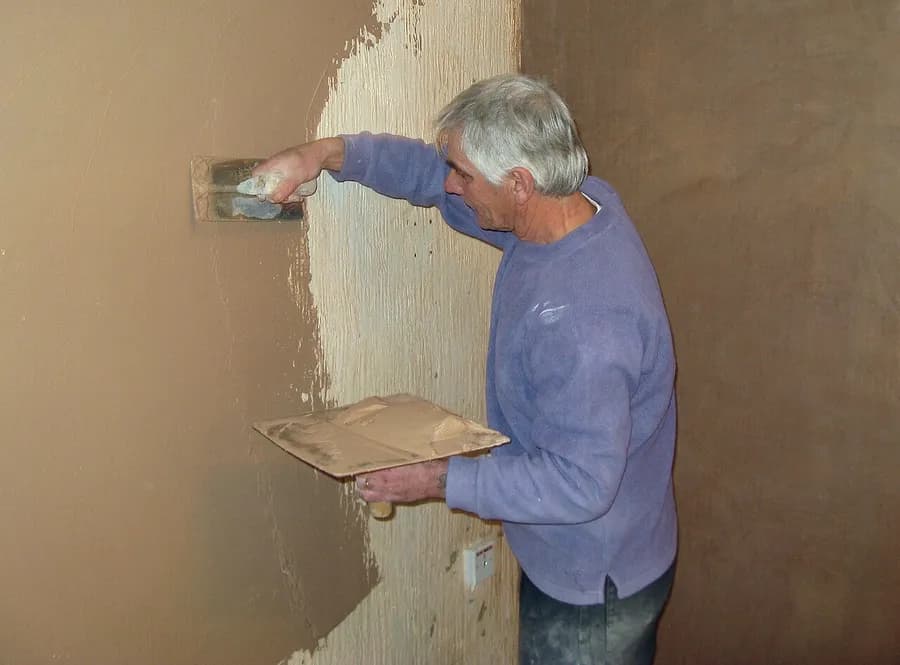
A plasterer laying the finish coat on an inside wall, with trowel and hawk.
Photo Adrian Pingstone · Public domain · Wikimedia Commons
At a glance
- Water
- Keep it dry
- Outside
- Indoors
- Floor
- Walls only
- Upkeep
- Almost none
- Vapour
- Vapour-open
What it is made of
Gypsum fired then reground, water, set retarders, sometimes pigments or lime to soften it.
Application
The support
A dry, clean support, never damp: brick, block, old plaster. On smooth or low-suction grounds, a bonding primer.
Tools
Bucket or trough, trowel, steel finishing trowel, straightedge, filling knife.
Steps
- 1Sprinkle the plaster into the water (not the other way), in small batches: it sets in tens of minutes.
- 2Lay the levelling coat and rule it.
- 3Trowel the finish coat smooth just as it starts to firm up.
Drying
Sets within the hour; dry through in one to three weeks before painting or coating.
The trade’s general sequence, at about 20 °C. Where a producer publishes its own data sheet, that sheet wins.
Price
One product, from a single producer
Cheapest pot
not published
Per kilo, from
not published
Per m², from
not published
| Product | From | €/kg · €/L | €/m² |
|---|---|---|---|
| Plâtres colorésSociété des Ocres de France | 18.89 € | — | — |
Material prices incl. VAT as published by this catalogue’s producers, samples excluded. Labour is never included, and a price per m² only exists where the producer publishes a coverage.
Upkeep
Nothing to do while it stays dry; it breaks down under standing damp and does not come back.
- Demands · Almost none
- Vapour-open