
The whole guide

Render: the finish that brings its own material

From a millimetre up, the finish stops following the wall and makes a new one. The relief you see is its own, the blade's, and the support disappears underneath. Four of this guide's finishes work at this thickness, and all they have in common is the gesture — the binders run from lime to cement, and it is the binder that decides where each one can go.

On a real wall

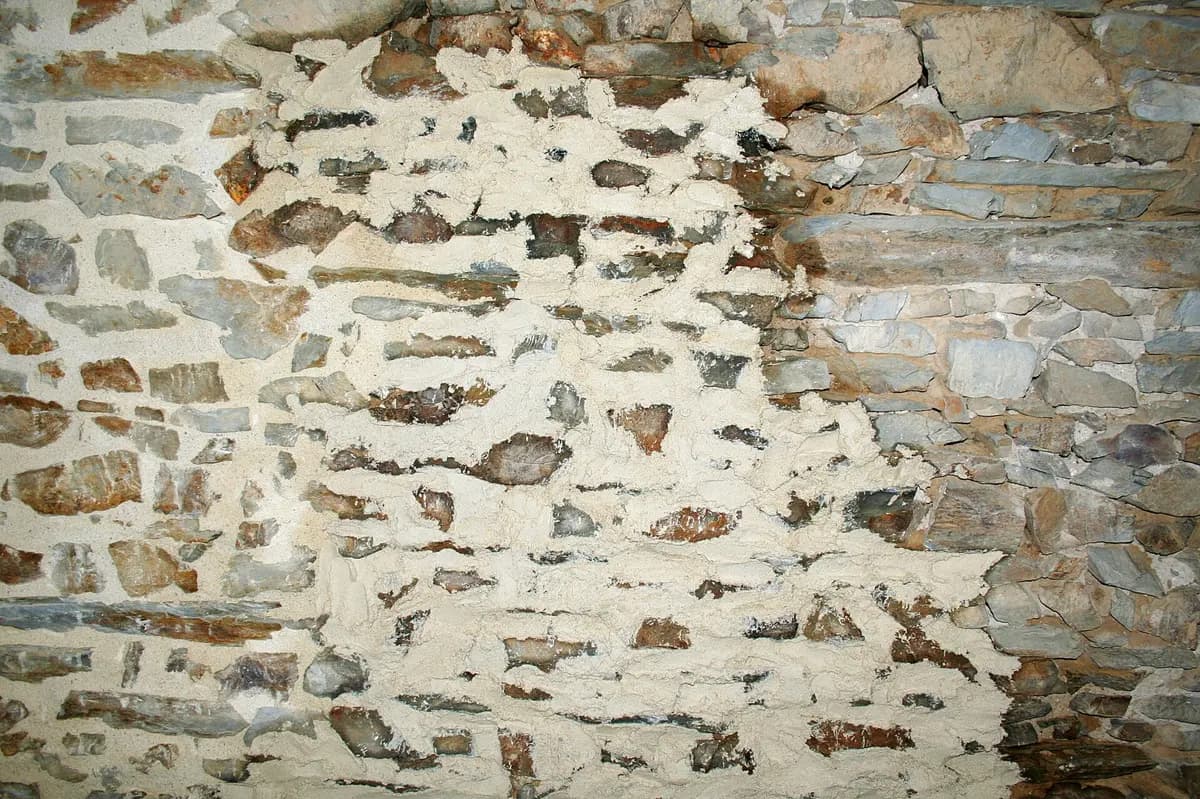
A lime render halfway across a rubble wall: bare masonry on the right, the material that has taken over on the left.

A lime render halfway across a rubble wall: bare masonry on the right, the material that has taken over on the left.

Photo Berrucomons · CC BY-SA 3.0 · Wikimedia Commons

How it goes on

You load the blade and pull the material in crossing passes, each thinner than the last, letting it set between them. The final pass makes the look: pressed, it compresses and smooths; eased off, it leaves the grain of the aggregate showing. A render cannot be rescued with a roller — of everything on this page, it is the finish that asks the most of the hand.

Render
One to three millimetres, off the blade. A material, with its own relief.

The finishes in this family

A lime-plastered wall on Tinos at sunset: the raking light picks out every pass of the hand left in the material.Render

Enduit à la chaux

Hydraulic lime (NHL) · 1–3 mm

A material rather than a colour: one to three millimetres trowelled on, giving the wall a relief and a depth no paint imitates.

Made of
Lime and sand batched by volume, coloured right through with pigments — and laid in three passes of decreasing grain: a very liquid keying coat (1:1 to 1:1.5, sand 0/4), a body coat that trues the wall (1:2.5 to 1:3, sand 0/2), a lean finish coat (1:3 to 1:4, sand 0/1). Air lime CL indoors, hydraulic NHL as soon as damp is involved.
Upkeep
Next to nothing: it ages well, repairs in patches, and lasts fifty years on a facade in the right NHL.
  • Steam only
  • Exposed
  • Walls only
  • Almost none
  • Vapour-open
Application, price and upkeep

A lime-plastered wall on Tinos at sunset: the raking light picks out every pass of the hand left in the material.

Photo Jules Verne Times Two · CC BY-SA 4.0 · Wikimedia Commons
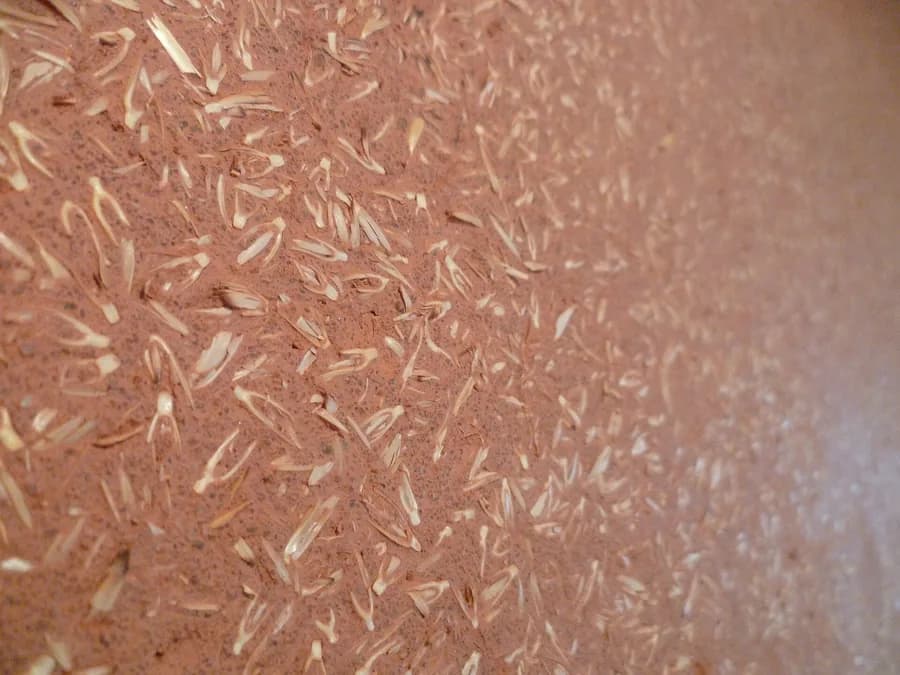
A decorative render of raw earth and grain husks: the fibre stays visible in the material, and it is the fibre that makes the pattern.Render

Enduit à l'argile

Clay · 1–3 mm

The render that regulates humidity best — and the one that least tolerates being wetted.

Made of
Clay as the binder, sand as the filler, plant fibres (straw, hemp) against shrinkage; no firing and no chemical set.
Upkeep
A soft cloth, never a scrub: a mark comes out by light sanding or a touch-up, not with a sponge.
  • Keep it dry
  • Indoors
  • Walls only
  • Periodic
  • Vapour-open
Application, price and upkeep

A decorative render of raw earth and grain husks: the fibre stays visible in the material, and it is the fibre that makes the pattern.

Photo Loïc ROSO · CC BY-SA 4.0 · Wikimedia Commons

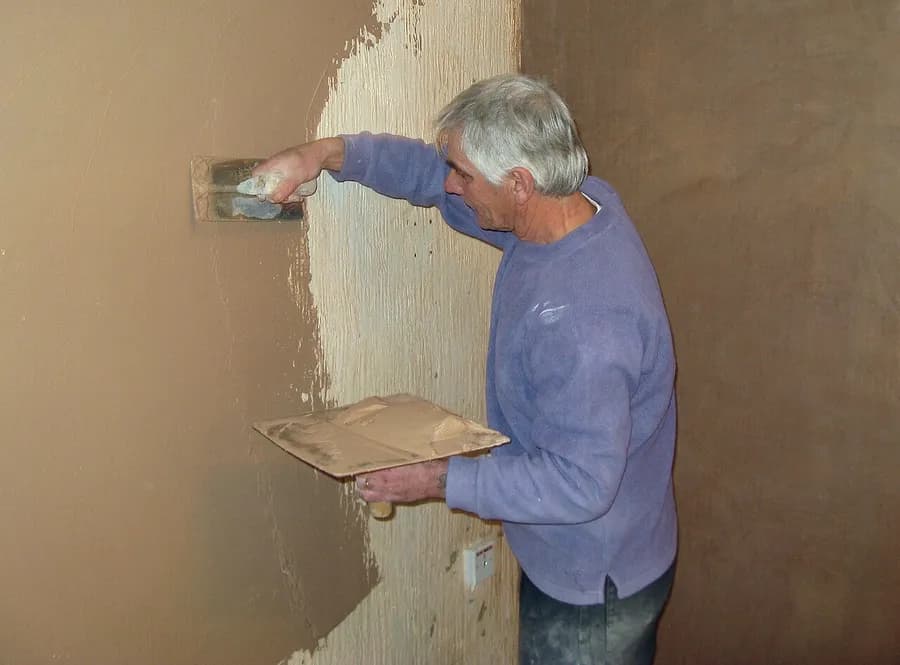
A plasterer laying the finish coat on an inside wall, with trowel and hawk.Render

Plâtre

Gypsum · 1–5 mm

The smoothest and whitest of interior renders, and no part of any wet room.

Made of
Gypsum fired then reground, water, set retarders, sometimes pigments or lime to soften it.
Upkeep
Nothing to do while it stays dry; it breaks down under standing damp and does not come back.
  • Keep it dry
  • Indoors
  • Walls only
  • Almost none
  • Vapour-open
Application, price and upkeep

A plasterer laying the finish coat on an inside wall, with trowel and hawk.

Photo Adrian Pingstone · Public domain · Wikimedia Commons

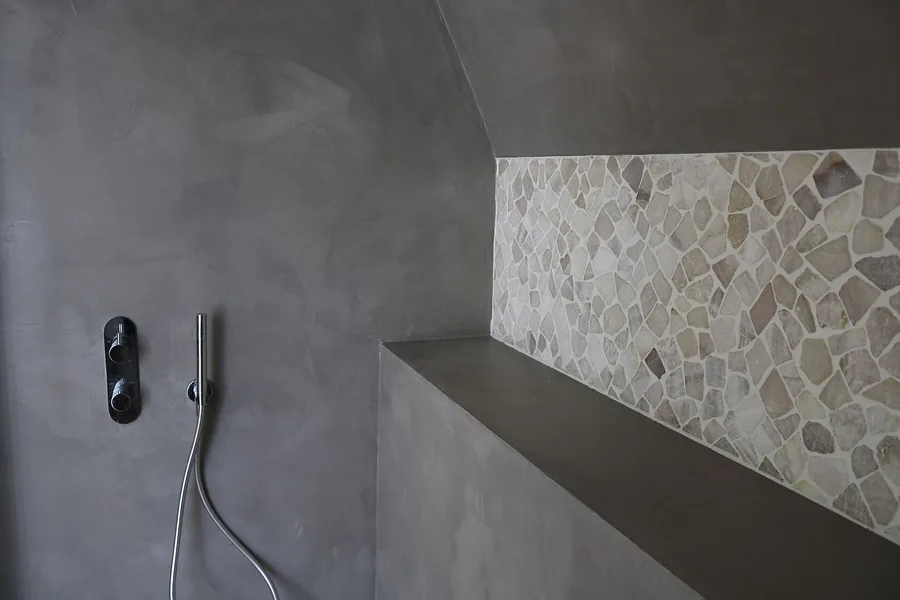
Béton ciré in a bathroom: walls and ledge in one continuous surface, without a joint, around a niche of pebbles.Render

Béton ciré

Cement + resin · 2–3 mm

A mineral render as one continuous surface with no joint anywhere — the only finish here that runs from floor to wall in a single material.

Made of
White Portland cement, mineral fillers (quartz, silica), pigments, and a polymer binder — the "resin" — at 10 to 40% of the cement weight: it is what gives grip, flexibility and freedom from shrinkage, and it is also what closes the wall.
Upkeep
Black soap and warm water; a coat of wax or sealer renewed every 12–18 months depending on traffic.
  • Shower
  • Exposed
  • Floor
  • Periodic
  • Closes the wall
Application, price and upkeep

Béton ciré in a bathroom: walls and ledge in one continuous surface, without a joint, around a niche of pebbles.

Photo Alex van Olst · CC BY-SA 4.0 · Wikimedia Commons

Where each one can go

ThicknessWaterOutsideFloorUpkeepVapour
Enduit à la chauxRender1–3 mmSteam onlyExposedWalls onlyAlmost noneVapour-open
Enduit à l'argileRender1–3 mmKeep it dryIndoorsWalls onlyPeriodicVapour-open
PlâtreRender1–5 mmKeep it dryIndoorsWalls onlyAlmost noneVapour-open
Béton ciréRender2–3 mmShowerExposedFloorPeriodicCloses the wall

Which one to choose

Hydraulic lime render is the only one of the four that will take a winter outdoors. Clay is made for a bedroom: it buffers humidity in the air and will not take liquid water. Gypsum stays indoors and dry, and gives the smoothest ground of all. Béton ciré is the only one that goes on a floor and into a shower — and the only one that seals the wall, which is expensive on old masonry.

The other thicknesses